
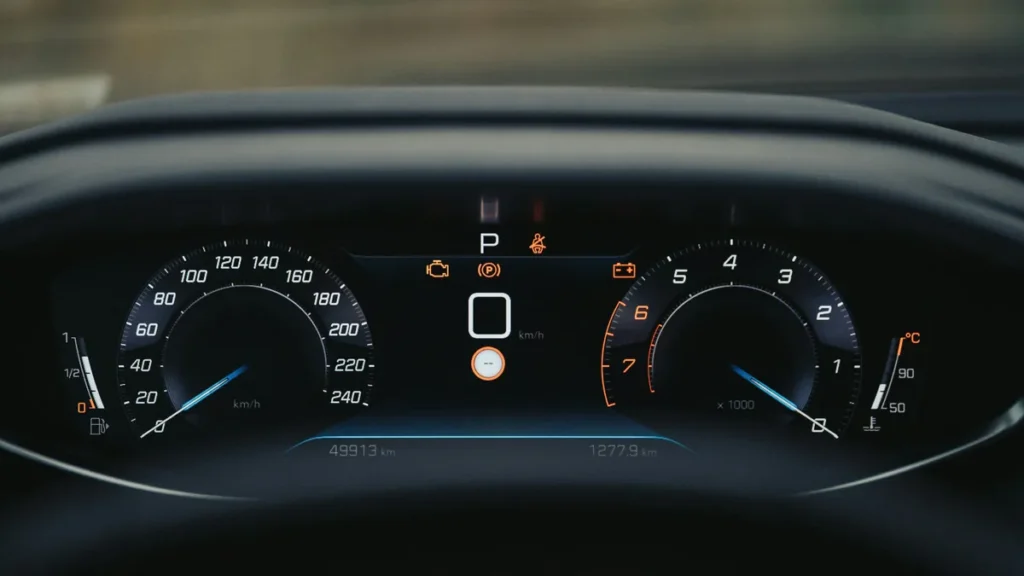
The check engine light is your car’s way of saying it has stored a fault code. Sometimes it’s nothing more than a loose gas cap. Sometimes it’s an early warning that can save you from a much bigger bill. Here’s what the light means, how urgent it is, what diagnosis costs in 2026, and what the most common fixes typically cost.
Steady vs. flashing: how urgent is it?
| What you see | What it means | What to do |
|---|---|---|
| Steady light | A fault has been stored. Usually not an emergency. | Get the code read within a few days. |
| Flashing light | An active, severe misfire. Unburned fuel can overheat and destroy the catalytic converter. | Reduce speed, avoid hard acceleration and get the car checked as soon as it’s safe. Stop driving if it runs badly. |
| Light plus other warnings | Low oil pressure, overheating or red warning lights. | Pull over safely and turn off the engine. |
What the light actually means
Since 1996, every car sold in the US has an OBD-II (on-board diagnostics) system. When a sensor reports something outside its normal range, the engine computer stores a five-character code, such as P0420, and turns on the light. The code tells you which system has a problem, not exactly which part to replace. That’s why a proper diagnosis matters before you buy parts.
Look up any code in our OBD-II code library to see what it means, the common causes and how urgent it is.
Most common causes
| Cause | Typical code(s) | Typical repair cost |
|---|---|---|
| Loose, cracked or missing gas cap | P0455, P0457 | $0–$40 (tighten or replace the cap) |
| Oxygen (O2) sensor | P0130–P0167 | About $160–$270 |
| Engine misfire (spark plugs, coils) | P0300–P0308 | Spark plugs about $290–$400; coils extra |
| Catalytic converter efficiency | P0420, P0430 | About $1,600–$2,500 for a converter |
| Mass airflow (MAF) sensor | P0100–P0104 | Cleaning is cheap; replacement varies by car |
| EVAP system leak | P0440–P0456 | Varies: hoses and valves are often modest repairs |
Repair costs are typical national ranges for parts and labor. Catalytic converter figures are based on RepairPal’s national average of $2,280–$2,480, with popular models such as the Ford F-150 ($1,591–$1,656) and Toyota Camry ($1,872–$1,950) coming in lower.
How much does diagnosis cost?
- Free code read: most auto parts stores will read the code at no charge. This tells you the code, not the cause.
- Your own scanner: a basic OBD-II reader costs about $20–$40 and plugs in under the dashboard.
- Professional diagnosis: about $100–$200 at most shops. This includes testing to find the actual failed part. Many shops credit the fee toward the repair if you have them do it.
The repair itself is a separate cost. It can be $0 (tightening the gas cap) or several thousand dollars (a catalytic converter). Paying for a proper diagnosis is usually cheaper than guessing and replacing parts that weren’t broken.
How a shop diagnoses the light
A code read takes a minute. A real diagnosis takes longer, because the code is only the starting point. A good technician will usually:
- Read all stored and pending codes, plus “freeze frame” data showing the conditions when the fault happened.
- Check for technical service bulletins: known problems and fixes the manufacturer has published for your model.
- Look at live sensor data while the engine runs to see which reading is out of range.
- Inspect the suspected area for loose connectors, cracked hoses, vacuum leaks or damaged wiring.
- Test the suspect part directly before recommending a replacement.
This is why two shops can quote very different repairs for the same code. One may replace the part named in the code. The other tests it first and finds that a $20 vacuum hose was the real problem. Ask how the shop confirmed the diagnosis.
What to do when the light comes on
- Check the gas cap. Tighten it until it clicks, then drive normally for a few days. The light may go off on its own.
- Notice how the car drives. Rough running, shaking, loss of power or strange smells make it more urgent.
- Get the code read (free at a parts store, or with your own scanner).
- Look up the code in our code library so you understand it before talking to a shop.
- For anything beyond a gas cap, get a professional diagnosis and an itemized quote.
Will the light reset itself?
Often, yes. If the problem goes away (a tightened gas cap, for example), the light usually turns off after several normal drive cycles. Clearing the code with a scanner turns the light off immediately, but if the fault is still there it will come back. Don’t clear codes right before an emissions inspection: the car’s readiness monitors reset too, and many states will fail the car until they complete.
Check engine light and emissions tests
In most states that require emissions testing, a car with the check engine light on fails automatically. If you have an inspection coming up, deal with the light first.
How to avoid overpaying
- Ask the shop for the exact code and their test results, not just a list of parts.
- Be cautious if a shop suggests replacing several parts at once “to be safe.”
- For expensive repairs like a catalytic converter, ask whether a faulty oxygen sensor or misfire could be causing the code. Fixing the root cause first can save thousands.
- Get a second quote for any repair over about $500.
Related guides
FAQ
Can I drive with the check engine light on?
If it’s steady and the car drives normally, usually yes, for a short time. Get it checked soon. If it’s flashing, or the car runs badly, limit driving and get it checked right away to avoid damaging the catalytic converter.
Can a loose gas cap really trigger it?
Yes. It’s one of the most common causes. A loose cap lets fuel vapors escape, which the EVAP system reports as a leak.
Does the light mean my engine is about to fail?
Rarely. Most codes point to sensors, ignition parts or emissions components. Ignoring the light for months, though, can turn a small repair into a big one.
Why did the light come on and then go off?
Some faults are intermittent. The code usually stays stored in the computer for a while, so a scan can still show what happened.
Prices are estimates for general guidance, based on published 2026 data from RepairPal, RepairPal (spark plugs) and Jerry. Your price depends on your vehicle, location and shop.